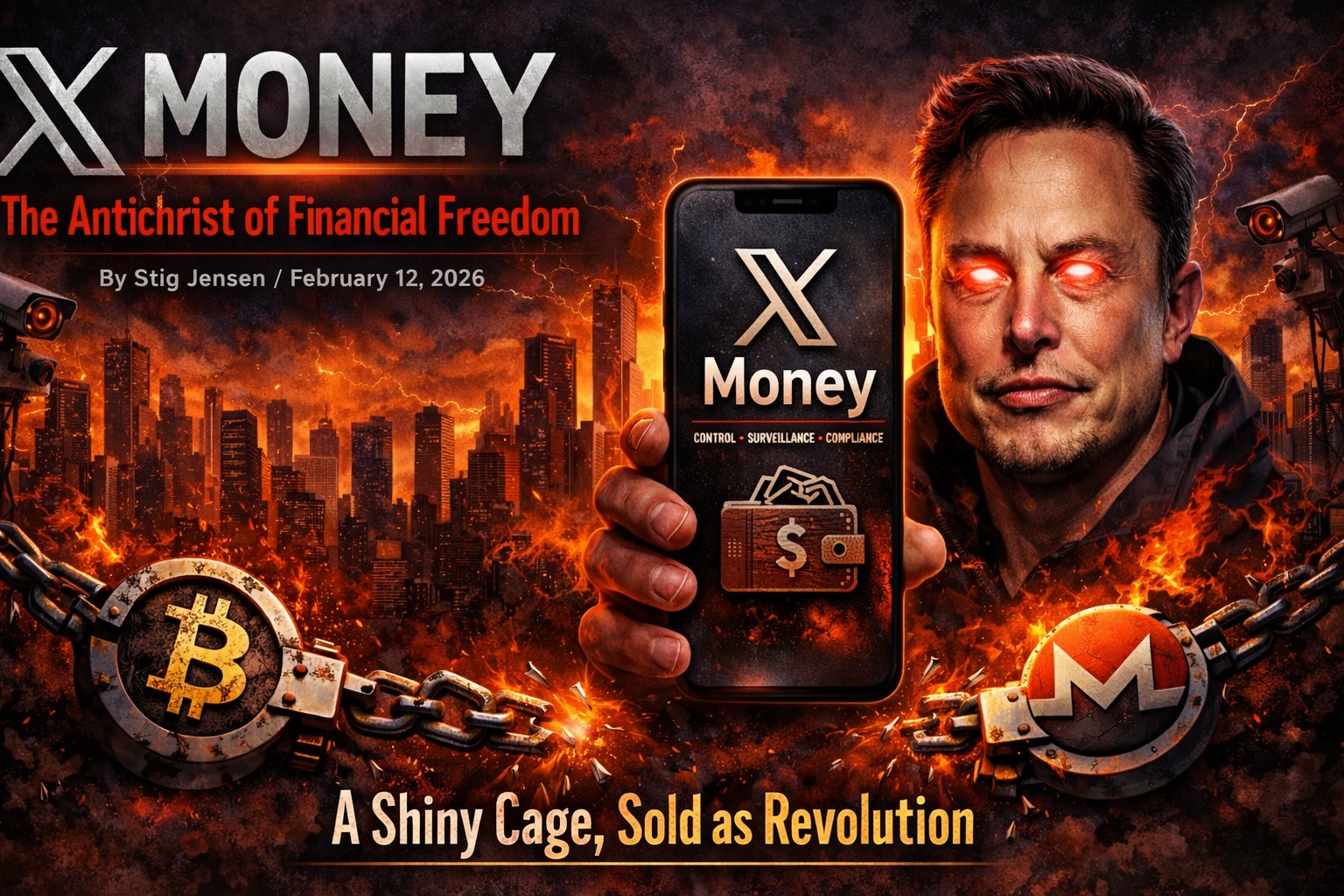
How Elon Musk is selling you a shinier cage and calling it revolution.
Elon Musk wants to put a wallet in your X account. Send money instantly. Tip creators. Pay for stuff without leaving the app. He’s calling it a “game changer” and promises it’ll become “the central source of all monetary transactions.”
Sounds convenient. Sounds disruptive. Sounds like freedom.
It’s none of those things.
X Money is the exact opposite of everything Bitcoin and Monero stand for. It’s not a revolution, it’s a rebranding. Same fiat rails. Same surveillance. Same central control. Just wrapped in the language of innovation and sold by a billionaire who should know better.
Let’s dissect the corpse.
The Architecture of Control
Here’s what X Money actually is under the hood:
- Fiat-first, fiat-always. Built on Visa Direct and traditional banking infrastructure. Licensed money transmitter in 40+ US states. This isn’t disruption, it’s integration. You’re not escaping the system, you’re getting a friendlier interface for it.
- Full KYC/AML compliance. Government ID required. Bank Secrecy Act. PATRIOT Act. Every transaction logged, monitored, and traceable. The “unbanked” marketing is a lie, KYC excludes the same people traditional banks do.
- Centralized custody. They hold your funds. Not your keys, not your coins, not your money. You’re trusting X Payments LLC with your balance and hoping they don’t pull a PayPal.
- Platform-tied identity. Your wallet is your X account. Get banned for a spicy tweet? Good luck accessing your funds during the “review process.”
Compare this to Bitcoin:
| Principle | Bitcoin/Monero | X Money |
|---|---|---|
| Control | You | Elon |
| Permission needed | No | Yes (KYC) |
| Censorship resistance | Absolute | Zero |
| Privacy | Pseudonymous/Private | Full surveillance |
| Custody | Self | Custodial |
| Protocol | Open, immutable | Proprietary, changeable |
| Money supply | Fixed/Predictable | Fiat inflation exposure |
X Money isn’t Bitcoin with better UX. It’s PayPal with a blue checkmark.
The Questions They Don’t Want You to Ask
When the hype machine is running, nobody asks the uncomfortable questions. Here are the ones that matter:
On your funds:
- Who earns interest on balances held in X Wallets? (Hint: not you.)
- What are the withdrawal limits and delays?
- If X goes bankrupt, is your money protected? FDIC insured? Or just gone?
On deplatforming:
- If your account gets suspended for content violations, can you still access your wallet?
- How long can they legally hold your funds during an “investigation”?
- Can Terms of Service violations freeze your money even if you broke no actual laws?
On surveillance:
- Will your spending patterns feed their ad targeting algorithms?
- Can they sell your financial behavior to third parties?
- When the government comes knocking with a subpoena, what do they hand over?
On the endgame:
- What stops them from jacking up fees once they’ve crushed competitors?
- If X becomes your social life, your payments, your identity, what leverage do you have when you disagree with a policy change?
- Is this infrastructure that can be weaponized against you on request?
These aren’t paranoid hypotheticals. PayPal has frozen accounts for political reasons. Banks have debanked entire industries. Centralized payment rails have always been tools of control first, convenience second.
X Money isn’t building something new. It’s adding another tollbooth to the same road.
The Musk Paradox
Here’s what makes this particularly insulting: Musk knows better.
He’s pumped Bitcoin. He’s memed Dogecoin into the stratosphere. He understands decentralization, censorship resistance, and why trusted third parties are security holes. He’s read the cypherpunk literature, or at least he’s pretended to.
And then he builds this.
A centralized, surveilled, custodial, fiat-dependent payment system tied to a social media platform he controls absolutely.
This isn’t ignorance. It’s a choice. Musk looked at the principles of monetary freedom and decided he’d rather be the bank than free the users.
The “everything app” vision isn’t liberation, it’s consolidation. One app. One account. One killswitch. When everything about your digital life flows through a single point, that point owns you.
WeChat is the model here, and if you think that’s freedom, ask a Chinese citizen how freely they speak when their social credit score is tied to their wallet.
The Small Country Problem
If you’re not in the US or a major Western market, X Money is even more useless.
The platform already algorithmically favors English content and American audiences. Growing a following from a small country is swimming upstream. Now add payments:
- Limited or delayed rollout to smaller nations
- Conversion fees eating your earnings
- Payout restrictions based on jurisdiction
- Zero recourse when something goes wrong — you’re not their priority customer
X Money makes it easier to spend money. It doesn’t make it easier to earn money if you’re outside the privileged markets. For creators in smaller countries, it’s another tool optimized for American consumers, not global participants.
You get to watch the party through the window.
The Real Alternatives
If you actually want financial freedom, not the branded, sanitized, Musk-approved version, the tools exist. They’ve existed for over a decade.
Bitcoin: Permissionless, borderless, censorship-resistant. Nobody can freeze your wallet. Nobody can inflate away your savings. Self-custody means self-sovereignty. Yes, it’s volatile. Yes, it takes learning. That’s the price of freedom.
Monero: Everything Bitcoin offers, plus actual privacy. Fungible, untraceable, and built specifically to resist surveillance. If financial privacy matters to you, this is the only serious option.
Self-custody: Hardware wallets. Your keys, your coins. No counterparty risk. No platform dependency. Learn it. Use it. This is the foundation everything else builds on.
Decentralized exchanges: Trade without KYC. Harder to use, but no middleman holding your funds or your identity.
The learning curve is steeper. The UX is rougher. That’s because nobody is spending billions to make freedom convenient, there’s no profit in liberating you.
But it works. It’s been working. And it doesn’t require trusting a billionaire who changes his mind every news cycle.
Conclusion: Recognize the Pattern
X Money isn’t new. It’s the same pattern we’ve seen for decades:
- Identify something people want (financial freedom, disruption, sticking it to the banks)
- Build a product that sounds like that thing
- Deliver the exact opposite wrapped in revolutionary language
- Profit from the confusion
Musk is playing the disruption card while building dependency infrastructure. He’s using the language of freedom to sell a product that increases control.
Don’t fall for it.
The real revolution already happened. It’s called Bitcoin. It’s boring now. It doesn’t have a charismatic billionaire tweeting about it every day. It just works, quietly, in the background, for anyone who bothers to learn it.
X Money is the antichrist of financial freedom, wearing the robes, speaking the words and leading people exactly where they shouldn’t go.
Keep your keys. Keep your coins. Keep your freedom.
BlackBox exists to cut through the noise. If you found this useful, share it with someone
who’s about to hand their financial life to a social media platform.